
Some of the best wildlife moments on our kaieteur falls tour begins with a sound. The red howler monkey fits that pattern perfectly. You might be walking through quiet forest or drifting along a slow river when, suddenly, the air fills with a deep, resonant roar that seems to come from everywhere at once.
Then, if you look up, you may catch a glimpse: a reddish-brown body moving through the canopy, a long tail wrapped around a branch, and a dark face watching from above.
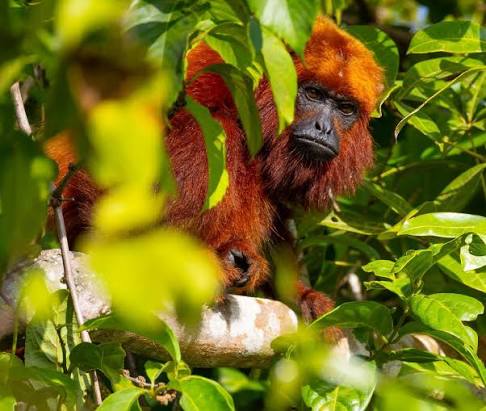
Table of Contents
The red howler monkey, Alouatta seniculus, is one of the largest New World monkeys and one of the most widespread primates in South America. It lives in rainforests, dry forests, gallery forests, and even some savanna woodlands across much of the continent. In protected areas and along remote rivers, where tall trees and continuous canopy remain, howler monkeys find the space they need to feed, rest, and raise their young.
Sightings are rare, but hearing a troop call at dawn or dusk, or spotting them moving through the treetops, is one of those experiences that stays with you long after the trip is over.
Once you’ve heard a red howler, it’s hard to forget. Males have an enlarged hyoid bone in the throat that acts like a natural amplifier, allowing their calls to carry for several kilometres through dense forest.
The call is deep and resonant, often described as a roar or growl. Troops use it to announce their presence, defend territory, and communicate with other groups without needing to move through the canopy.
In many places, the dawn and dusk choruses of howler monkeys are as much a part of the soundscape as the rustle of leaves or the call of birds. For visitors, hearing them for the first time can be a surprising and powerful introduction to the forest.
Habitat and Range
The red howler monkey occurs across much of northern and western South America. Its range includes Venezuela, Colombia, Ecuador, Peru, Brazil, Bolivia, Guyana, French Guiana, Suriname, and Trinidad and Tobago.
It favours the canopy of tropical rainforests but also uses dry deciduous forests, gallery forests along rivers, cloud forests, mangrove swamps, and some savanna woodlands. It is most common in lowland areas but has been recorded at higher elevations in the Andes.
Continuous canopy and tall trees are important. Howlers spend most of their time high in the treetops, moving along branches and using their long, prehensile tail as a fifth limb for balance and support.
What Does It Eat?
Red howler monkeys are primarily herbivores with a diet focused on leaves and fruit. Leaves can make up more than half of what they eat, especially when fruit is less available.
They also consume buds, flowers, seeds, twigs, stems, and occasionally soil from termite hills. In some areas, they feed on dozens of plant species, shifting their diet with the seasons and local availability.
Because they swallow seeds and move through large areas of forest, howler monkeys help disperse seeds and contribute to forest regeneration.
Life in a Troop
Red howler monkeys live in social groups called troops. A typical troop ranges from about 2 to 13 individuals, often with one or two adult males, several adult females, and their offspring.
Adult males that are not dominant may live alone or in small bachelor groups. Troops defend territories with vocal displays and, if necessary, physical confrontations with neighbouring groups.
Most movement happens in the canopy. Howlers are relatively slow and deliberate compared to other monkeys, conserving energy by resting for much of the day and feeding in short bouts.
Young Monkeys and Family Care
Infant howler monkeys are born with a dark coat that gradually changes as they mature. For the first weeks and months, they cling tightly to their mother’s belly or back.
Mothers carry their young while moving through the trees, feeding, and resting. Other members of the troop, especially females, may help watch and protect infants.
As juveniles grow, they begin to explore nearby branches, play with other young monkeys, and learn the routes and feeding trees used by the troop.
Signs You May Find
Even if you do not see red howler monkeys directly, there are signs that can tell you they are in the area:
- Calls: Deep, resonant roars, especially at dawn and dusk, often lasting several minutes.
- Droppings: Faeces on the forest floor or on large branches, sometimes containing visible seeds and fruit fragments.
- Resting sites: Groups sleeping or resting high in the canopy, often in the same trees on successive days.
- Broken branches and stripped leaves: Evidence of feeding and movement through the treetops.
Learning to read these signs can make a walk through the forest feel more like following a story written in the landscape.
Conservation and Protection
The red howler monkey is currently classified as Least Concern on the IUCN Red List, thanks to its wide distribution and adaptability to different forest types. However, local populations face growing pressures.
- Habitat destruction from logging, forest clearance for agriculture, cattle ranching, and infrastructure development.
- Hunting for meat and, in some areas, capture for the pet trade.
- Disease outbreaks, including yellow fever, which can cause significant mortality in some regions.
- Fragmentation, which isolates troops and reduces access to food and mates.
In some parts of its range, especially where forests are heavily fragmented or hunting is intense, red howler populations are declining and may warrant greater protection.
How to Watch Responsibly
Seeing red howler monkeys in the wild requires patience and respect for the animals and their habitat.
- Go with experienced guides who know the area and follow ethical wildlife-viewing practices.
- Keep a safe distance and avoid approaching, chasing, or attempting to feed monkeys.
- Move quietly and give the troop space to continue its natural behaviour.
- Support lodges, reserves, and community projects that contribute to habitat protection and anti-poaching efforts.
Responsible tourism can help make howler monkeys more valuable alive than hunted, and can support the people who live alongside them.
A Memorable Part of South America’s Wildlife
The red howler monkey is not just another primate. It is one of the defining voices of the South American forest, a species that shapes the soundscape and helps maintain the health of the canopy through its feeding and seed dispersal.
Hearing a troop call at first light, or watching them move through the treetops with infants clinging to their backs, can become one of the most memorable moments of a trip to South America.
Frequently Asked Questions
Where can red howler monkeys be seen?
Red howler monkeys can be seen in large, protected areas of rainforest, dry forest, and gallery forest. Good regions include the Amazon Basin (Brazil, Peru, Colombia, Bolivia), the Guianas (Guyana, French Guiana, Suriname), Venezuela, Ecuador, and Trinidad and Tobago.
Are red howler monkeys dangerous?
Red howler monkeys are generally shy and avoid people. They are not aggressive, but they are strong wild animals. It is important to keep a safe distance and never attempt to approach, feed, or corner them.
What is the scientific name of the red howler monkey?
The scientific name of the red howler monkey is Alouatta seniculus. It is also known as the Guyanan red howler or Colombian red howler, depending on the region
What does a red howler monkey eat?
Red howler monkeys eat mainly leaves and fruit, along with buds, flowers, seeds, twigs, stems, and occasionally soil from termite hills. Leaves can make up more than half of their diet.
Why do howler monkeys howl?
Howler monkeys howl to communicate with other troops, defend territory, and announce their presence. Males use their loud calls to warn neighbouring groups and reduce the need for direct physical confrontations.
What is the best way to see one?
The best way to see red howler monkeys is with experienced local guides in areas where they are known to occur. Dawn and dusk near rivers, forest edges, and tall canopy trees offer the best chances. Patience, quiet movement, and ethical behaviour increase your chances of a meaningful sighting.