
Some of the most striking wildlife moments on our kaieteur Tour happen high above your head. The Guianan spider monkey fits that pattern perfectly. You might be walking through tall rainforest or drifting along a slow river when you notice long, dark limbs moving through the canopy, a tail wrapped around a branch, and a reddish face peering down from the treetops.
Then, if you listen closely, you may hear soft grunts, barks, or squeaks as the troop moves from tree to tree, almost like a distant conversation in the leaves.
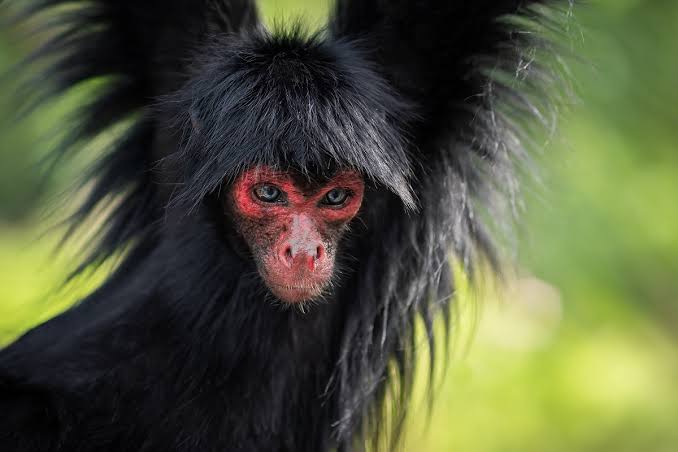
Table of Contents
The Guianan spider monkey, Ateles paniscus, is one of the largest New World monkeys and a true specialist of the high canopy. It lives in primary rainforests across the Guiana Shield and nearby regions. In protected areas and remote tracts of undisturbed forest, where tall trees and continuous canopy remain, spider monkeys find the space they need to feed, travel, and raise their young.
You’re never promised a sighting. But spotting a troop swinging through the treetops, or hearing them move through the canopy, is one of those experiences that stays with you.
Built for the Canopy
Once you’ve seen a spider monkey in motion, the name makes perfect sense. Their long, slender limbs and extremely long prehensile tail give them a spider-like appearance as they swing, climb, and hang from branches.
The tail is especially important. It acts as a fifth limb, strong enough to support the monkey’s full body weight while it reaches for fruit or moves between trees. This allows spider monkeys to spend almost all of their time in the middle and upper levels of the canopy, rarely coming down to the forest floor.
Their small heads, long arms, and hook-like hands are all adapted for life in the treetops. In many ways, they are among the most specialised primates in the South American rainforest.
Habitat and Range
The Guianan spider monkey occurs across the Guiana Shield and adjacent areas of northern South America. Its range includes Brazil (north of the Amazon), French Guiana, Guyana, Suriname, and possibly eastern Venezuela.
It favours undisturbed primary rainforest with tall, continuous canopy. It is most common in lowland evergreen rainforest and high forest on hills and mountains, and it rarely uses edge habitats, secondary growth, or heavily disturbed areas.
Studies in Suriname and Guyana show that spider monkeys spend the majority of their time in the upper canopy and emergent trees, often above 12 metres and frequently much higher. They prefer forests with canopy heights exceeding 25 metres and need large, connected areas of forest to survive.
What Does It Eat?
Guianan spider monkeys are primarily frugivores, meaning fruit makes up most of their diet. In some studies, mature fruit accounts for more than 80% of what they eat.
They also consume flowers, young leaves, bark, roots, bulbs, honey, and occasionally insects such as termites and grubs. They feed on a wide variety of plant species and shift their diet with the seasons and local availability.
Because they swallow seeds and travel long distances through the canopy, spider monkeys play an important role in seed dispersal. This helps maintain forest diversity and regeneration, especially for large-seeded trees.
Life in a Troop
Guianan spider monkeys live in social groups called troops. A typical troop can range from about 4 to 25 individuals, though they often split into smaller subgroups during the day to forage.
These subgroups come back together to sleep in the same trees at night. Troops may include several adult males and females, along with their offspring. Males and females both participate in group movement and defence of the home range.
Spider monkeys are diurnal, active during the day and resting at night. They cover large distances as they search for fruiting trees, making them one of the most mobile primates in the forest.
Young Monkeys and Family Care
Infant spider monkeys are born with a dark coat and cling tightly to their mother’s belly or back in the first weeks and months. Mothers carry their young while moving through the trees, feeding, and resting.
Other members of the troop, especially females, may help watch and protect infants. As juveniles grow, they begin to explore nearby branches, play with other young monkeys, and learn the routes and feeding trees used by the troop.
Spider monkeys have a relatively slow reproductive rate, with females giving birth to a single infant after a long gestation. This makes populations more vulnerable to hunting and habitat loss.
Signs You May Find
Even if you do not see Guianan spider monkeys directly, there are signs that can tell you they are in the area:
- Calls and sounds: Soft grunts, barks, and squeaks from the canopy, often as the troop moves between trees.
- Droppings: Faeces on the forest floor or on large branches, sometimes containing visible seeds and fruit fragments.
- Resting sites: Groups sleeping or resting high in the canopy, often in the same trees on successive days.
- Broken branches and stripped fruit: Evidence of feeding and movement through the treetops.
Learning to read these signs can make a walk through the forest feel more like following a story written in the landscape.
Conservation and Protection
The Guianan spider monkey is classified as Vulnerable on the IUCN Red List. Populations have declined by at least 30% over recent decades, primarily due to hunting and habitat loss.
- Habitat destruction from logging, forest clearance for agriculture, mining, and infrastructure development.
- Hunting for bushmeat, which is a major threat across much of its range.
- Fragmentation, which isolates troops, reduces access to food, and increases exposure to hunters.
- Slow reproductive rate, which makes it harder for populations to recover from losses.
Spider monkeys are especially sensitive to disturbance because they depend on large areas of undisturbed primary forest with tall, continuous canopy. In places where forests are heavily fragmented or hunting is intense, local populations can disappear quickly.
How to Watch Responsibly
Seeing Guianan spider monkeys in the wild requires patience and respect for the animals and their habitat.
- Go with experienced guides who know the area and follow ethical wildlife-viewing practices.
- Keep a safe distance and avoid approaching, chasing, or attempting to feed monkeys.
- Move quietly and give the troop space to continue its natural behaviour.
- Support lodges, reserves, and community projects that contribute to habitat protection and anti-poaching efforts.
Responsible tourism can help make spider monkeys more valuable alive than hunted, and can support the people who live alongside them.
A Memorable Part of South America’s Wildlife
The Guianan spider monkey is not just another primate. It is one of the true specialists of the rainforest canopy, a species that helps shape the forest through its feeding and seed dispersal.
Watching a troop swing through the treetops, infants clinging to their mothers, can become one of the most memorable moments of a trip to South America.
Frequently Asked Questions
Where can Guianan spider monkeys be seen?
These spider monkeys can be seen in large, protected areas of primary rainforest in the Guiana Shield region, including Guyana, Suriname, French Guiana, and northern Brazil (north of the Amazon). They are most often found in undisturbed lowland and high forests with tall, continuous canopy.
Are Guianan spider monkeys dangerous?
Guianan spider monkeys are generally shy and avoid people. They are not aggressive, but they are strong wild animals. It is important to keep a safe distance and never attempt to approach, feed, or corner them.
What is the scientific name of the Guianan spider monkey?
The scientific name of the Guianan spider monkey is Ateles paniscus. It is also known as the black spider monkey or red-faced spider monkey.
What does a Guianan spider monkey eat?
Guianan spider monkeys eat mainly mature fruit, along with flowers, young leaves, bark, roots, bulbs, honey, and occasionally insects such as termites and grubs. Fruit typically makes up most of their diet.
Why are spider monkeys important for the forest?
Spider monkeys eat a wide variety of fruits and disperse the seeds over long distances through their droppings. This helps regenerate forests, especially for large-seeded trees that smaller animals cannot handle.
What is the best way to see one?
The best way to see Guianan spider monkeys is with experienced local guides in areas where they are known to occur. Dawn and dusk near tall primary forest, rivers, and known feeding trees offer the best chances. Patience, quiet movement, and ethical behaviour increase your chances of a meaningful sighting.