
Some of Guyana’s most fascinating animals are not the easiest to spot. The giant anteater is a good example. It does not make much noise, moves slowly, and often blends into the grass and low vegetation.
Then, suddenly, you may notice its long snout, enormous bushy tail, and unusual black-and-white markings moving across the landscape.
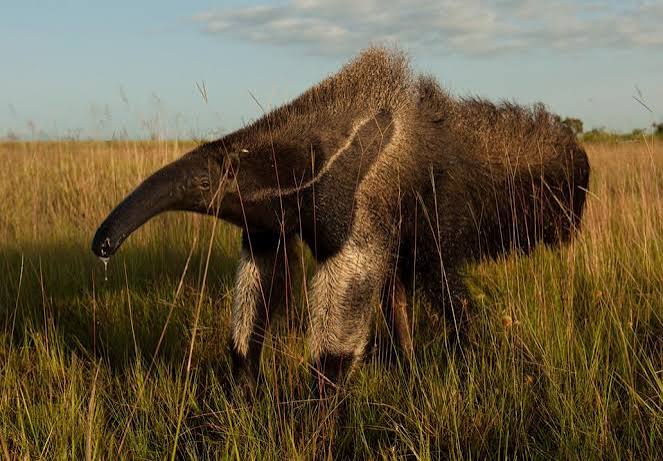
The giant anteater, Myrmecophaga tridactyla, is one of the most distinctive mammals in South America. It can be found in forests, savannas, wetlands, and open grasslands. Around Kaieteur Falls and Orinduik Falls, the surrounding mix of habitats provides the kind of environment this unusual animal needs.
Table of Contents
A sighting is never guaranteed, but seeing a giant anteater in the wild is an experience many visitors remember long after their trip has ended.
An Unmistakable Animal
It is difficult to confuse a giant anteater with any other animal. Its long, narrow snout gives it an almost curious expression, while its huge tail makes it look even larger.
The coat is usually a mixture of grey, brown, black, and white. A strong dark stripe runs across the shoulders and along the sides of the body. These colours can provide surprisingly good camouflage, especially in dry grass or woodland shade.
The giant anteater also has powerful front claws. It walks on its knuckles to protect them while moving across the ground. When it finds a termite mound or ant nest, those claws become important tools for breaking into the colony.
Despite its name, the giant anteater does not have teeth. Instead, it uses a long, sticky tongue to collect ants and termites.
Habitat Around Kaieteur Falls
Kaieteur Falls is surrounded by rainforest, but the wider region is made up of more than dense forest. There are streams, open areas, forest edges, and different types of vegetation spread across the landscape.
That variety matters to giant anteaters. They need access to ant and termite colonies, but they also need places where they can rest and shelter from the heat.
The area immediately around the waterfall may not be the best place to look for one. Giant anteaters are wide-ranging animals, and they may travel far from tourist viewpoints. The most suitable areas can include open forest margins, grassland, savanna, and lightly wooded country.
If you are walking with a guide, it is worth asking about recent signs of activity. An opened termite mound or a trail through the grass may reveal that an anteater has passed through recently.
Around Orinduik Falls
Orinduik Falls lies on the Ireng River, close to Guyana’s border with Brazil. The landscape around the falls includes rocky river scenery, open savanna, forest, and patches of lower vegetation.
This combination creates opportunities for wildlife, including the giant anteater. The animal may spend time in open areas searching for food before moving into nearby vegetation to rest.
Giant anteaters are slow, but they are not tied to one small location. They can travel considerable distances while looking for new ant and termite colonies. A quiet walk through suitable habitat may reveal one crossing open ground or slowly searching beneath fallen branches.
The animal may be easier to notice in the early morning or later in the day, when temperatures are more comfortable. Local conditions vary, so visitors should follow the advice of their guide rather than rely on a fixed wildlife schedule.
What Does It Eat?
Giant anteaters eat mainly ants and termites. They use their sense of smell to locate colonies, then open them with their sharp front claws.
Once the nest is exposed, the anteater quickly extends its long tongue into the opening. It does not stay in one place for too long. Moving on after a short time helps protect it from angry insects defending the colony.
Their diet may seem limited, but ants and termites are widespread and available in many different habitats. This allows giant anteaters to live in grasslands, woodland, wetlands, and forest-edge environments.
They may occasionally consume other soft-bodied insects, but ants and termites make up the main part of their diet.
A Solitary Way of Life
Giant anteaters generally travel alone. The main exception is a mother with her young.
They spend much of their time walking slowly with their nose close to the ground. Their strong sense of smell helps them find hidden insect colonies beneath the soil, inside termite mounds, and in fallen wood.
They may be active during the day or at night, depending on the temperature and the level of disturbance in the area. During hot periods, they may rest in shaded vegetation and become more active when conditions are cooler.
Although they usually avoid trouble, a giant anteater can defend itself if cornered. Its front claws are extremely powerful, so visitors should always give the animal plenty of room.
The Young Ride on Their Mother’s Back
Female giant anteaters usually raise one young at a time. During the early months, the baby rides on its mother’s back.
The young animal’s markings blend with the mother’s coat, making it less noticeable as she moves through the grass or woodland. The mother continues to carry it while searching for food and travelling through her territory.
Seeing a mother with a young one would be a particularly special sighting. It is also a reminder to keep a respectful distance and allow the family to continue moving naturally.
Signs You May Find
Even when a giant anteater stays hidden, it may leave clues behind. A guide may point out:
- A termite mound that has been opened.
- Disturbed soil around an ant nest.
- Long tracks through soft ground.
- Scratches on fallen timber.
- A narrow passage through tall grass.
- Fur caught on low branches.
- Fresh feeding sites.
These signs can be difficult to interpret without local experience. An opened termite mound, for example, may have been visited by several different animals. A knowledgeable guide can help explain what the evidence suggests.
Conservation and Protection
The giant anteater is classified as Vulnerable. Its numbers have declined in parts of its range because of habitat loss, fires, hunting, road collisions, and the deterioration of natural grasslands and forests.
The species also reproduces slowly, which makes population recovery difficult after serious losses. Protecting remaining habitat is therefore extremely important.
Guyana is an important place for giant anteater research and conservation. In the Rupununi, local organisations and communities have been involved in monitoring the species and improving awareness of its conservation needs.
This work is important because giant anteaters need connected habitats. Protecting only one small patch of land is not enough if the animals cannot safely move between feeding and resting areas.
How to Watch Responsibly
If you see a giant anteater during your trip, the best thing to do is remain calm and give it space.
- Stay with your guide.
- Keep a safe distance.
- Keep voices low.
- Do not approach or surround the animal.
- Never attempt to feed or touch it.
- Do not block its path.
- Avoid chasing it to get a photograph.
- Do not use flash photography at close range.
- Avoid posting the location of a mother and young animal.
The goal is to observe without changing the animal’s behaviour. A brief, peaceful sighting is far better than an encounter that causes stress.
A Memorable Part of Guyana’s Wildlife
The giant anteater may not be as well known as the jaguar or giant river otter, but it is just as remarkable. Its unusual appearance, specialised diet, and quiet way of life make it one of the most memorable animals in Guyana.
Visitors to Kaieteur Falls and Orinduik Falls come for the waterfalls, rivers, and dramatic scenery. Along the way, they may also discover a much quieter side of the landscape—one marked by termite mounds, animal tracks, and the slow movement of a giant anteater through the grass.
That is part of the appeal of wildlife in Guyana. You cannot always predict what you will see. Sometimes the most rewarding encounter is the animal you notice only after slowing down and looking carefully.
Frequently Asked Questions
Can giant anteaters be seen near Kaieteur Falls?
They may occur in suitable habitats in the wider Kaieteur region, but sightings are unpredictable. They can travel across large areas and are often difficult to notice.
Are giant anteaters found near Orinduik Falls?
The combination of savanna, forest edges, and open vegetation around Orinduik Falls may provide suitable habitat. A local guide can advise visitors about recent wildlife activity.
Are giant anteaters dangerous?
They usually avoid people, but their front claws are powerful. Never approach, touch, feed, or corner one.
What is the scientific name of the giant anteater?
Its scientific name is Myrmecophaga tridactyla.
What does a giant anteater eat?
It mainly eats ants and termites, which it collects with its long, sticky tongue.
What is the best way to see one?
Travel with an experienced local guide, move quietly, and observe open grassland, forest edges, and areas showing signs of termite or ant activity.
Join Gy Tours to explore the forests, savannas, rivers, and waterfalls of Guyana—and keep your eyes open for the distinctive silhouette of the giant anteater.