
Some of the best wildlife moments on our Kaieteur waterfall tours come when you least expect them. The South American tapir fits that pattern perfectly. It moves quietly through dense forest, often close to water, and can vanish into the shadows before you’re sure you actually saw it.
Then, out of nowhere, you catch a glimpse: a stocky, dark brown body slipping between trees, a short flexible snout testing the air, maybe the soft splash as it steps into a river.
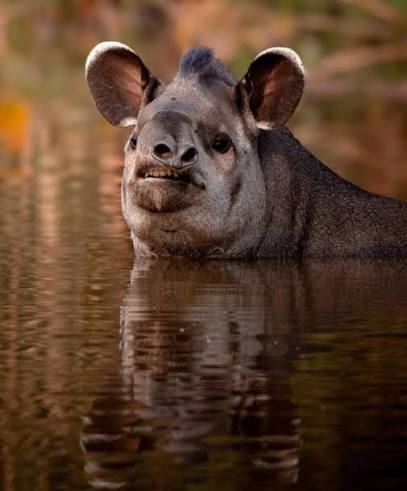
Table of Contents
The South American tapir, Tapirus terrestris, is the largest land mammal native to South America. It lives in rainforests, swamp forests, savannas, and dry forests across much of the continent. In protected areas and along remote rivers, where forest, water, and open ground meet, tapirs find the space they need to move, feed, and raise their young.
A sighting is never 100% guaranteed. But when it happens, it’s one of those moments that stays with you long after the trip is over.A Quiet Giant of the Forest.
Once a tapir is spotted, it’s hard to imagine confusing it with anything else. Its body is solid and barrel-shaped, with short legs and a short, mobile snout that it uses almost like a small trunk to sniff and pull at vegetation.
The coat is usually a uniform dark brown, sometimes a touch lighter around the head and neck. In dim light—dawn, dusk, or under thick canopy—that dark colour blends surprisingly well into shaded forest and river edges.
This animal does not rely on sharp eyesight. They make up for it with an excellent sense of smell and good hearing. They sniff the air constantly, listening for movement, other tapirs, or anything that doesn’t quite fit the rhythm of the forest.
Despite their size, they move quietly and tend to avoid open areas in bright daylight. Most activity happens in the early morning, late evening, and at night.
Habitat and Range
The South American tapir occurs across much of tropical South America east of the Andes. Its range stretches from Venezuela and Colombia through the Guianas, Brazil, Ecuador, Peru, Bolivia, Paraguay, and into northern Argentina.
It favours humid lowland rainforests and swamp forests near rivers, oxbow lakes, and wetlands. It also uses seasonally dry forests, savannas, and forest–savanna mosaics where water is still available.
Water is central to their daily routine. Tapirs bathe regularly, wallow in mud to cool off and shed parasites, and follow established trails that connect feeding areas, mineral licks, and water sources.
What Does It Eat?
The South American tapir is a browsing herbivore with a flexible, fruit-heavy diet. It feeds on leaves, shoots, stems, aquatic plants, and the fruit of many tree and palm species.
It uses its short snout to pull vegetation towards its mouth and can reach up to about two metres high when browsing. In some areas, palms and other large-seeded plants make up an important part of its diet.
Because it swallows many seeds intact and moves long distances, the tapir acts as an important seed disperser. This helps maintain forest structure and plant diversity over large areas.
A Solitary Way of Life
Tapirs are mostly solitary. Adults come together mainly to mate, and mothers stay with their young for a year or two before the juveniles disperse.
They move along permanent trails through the forest, often with their snout close to the ground to sniff for food, other tapirs, or signs of danger. Communication is subtle, using soft whistles, clicks, snorts, and scent marks along trails and at wallows.
In areas with little human disturbance, tapirs can be active at any time of day. Where hunting pressure is higher, they tend to become more nocturnal and more difficult to observe.
Calves with Stripes and Spots
Tapir calves are born with a striking coat pattern that is very different from adults. Their bodies are covered with light stripes and spots on a dark brown background.
This pattern helps young tapirs blend into dappled light and dense undergrowth, offering protection from predators such as jaguars and large cats. As they grow, the stripes and spots gradually fade, and the coat becomes more uniform.
Mothers are attentive and protective. Calves often stay close to their mothers, following them along familiar trails and learning where to find food, water, and safe resting places.
Signs You May Find
Even if you do not see a tapir directly, there are signs that can tell you one is in the area:
- Tracks: Large, rounded footprints with three or four toes, often visible on muddy trails and riverbanks.
- Dung: Piles of droppings along trails or near water, sometimes containing visible seeds and fruit fragments.
- Wallows and trails: Depressions filled with mud or water, and well-worn paths through vegetation leading to feeding areas and water sources.
- Broken vegetation: Bent or broken stems and branches where tapirs have been browsing.
Learning to read these signs can make a walk through the forest feel more like following a story written in the landscape.
Conservation and Protection
The South American tapir is listed as Vulnerable on the IUCN Red List. Populations have declined due to a combination of threats.
- Habitat loss and fragmentation from deforestation for agriculture, cattle ranching, oil palm plantations, mining, and new roads.
- Hunting for meat and hides, especially along frontier roads and near expanding settlements.
- Competition with livestock for forage and water, plus disease risk at shared resources.
- Road mortality, as highways and logging tracks cut through forests.
In some regions, such as the Atlantic Forest, populations are at risk of local extinction. Protecting large, connected areas of forest and reducing hunting pressure are key to the tapir’s long-term survival.
How to Watch Responsibly
Seeing a tapir in the wild requires patience and respect for the animal and its habitat.
- Go with experienced guides who know the area and follow ethical wildlife-viewing practices.
- Keep a safe distance and avoid approaching, chasing, or attempting to feed tapirs.
- Move quietly and give the animal space to continue its natural behaviour.
- Support lodges, reserves, and community projects that contribute to habitat protection and anti-poaching efforts.
Responsible tourism can help make tapirs more valuable alive than hunted, and can support the people who live alongside them.
A Memorable Part of South America’s Wildlife
The South American tapir is not just another large mammal. It is a quiet engineer of the forest, moving seeds across the landscape and helping shape the ecosystems it inhabits.
A glimpse of a tapir stepping out of the trees, wading into a river, or disappearing into the undergrowth can become one of the most memorable moments of a trip to South America.
Frequently Asked Questions
Where can South American tapirs be seen?
South American tapirs can be seen in large, protected areas of rainforest, swamp forest, and savanna. Good regions include the Brazilian Pantanal, parts of the Amazon Basin (Brazil, Peru, Colombia, Bolivia), Colombia’s Amazon and Orinoquía, and the Gran Chaco in Bolivia, Paraguay, and northern Argentina.
Are tapirs dangerous?
Tapirs are generally shy and avoid people. They are not aggressive, but they are large and powerful. If surprised or threatened, they can defend themselves. It is important to keep a safe distance and never attempt to approach or corner a tapir.
What is the scientific name of the South American tapir?
The scientific name of the South American tapir is Tapirus terrestris. It is also known as the lowland tapir or Brazilian tapir.
What does a South American tapir eat
South American tapirs eat leaves, shoots, stems, aquatic plants, and the fruit of many tree and palm species. They are primarily browsing herbivores with a fruit-heavy diet.
Why are tapirs important for the forest?
Tapirs eat a wide variety of fruits and disperse the seeds over long distances through their droppings. This helps regenerate forests, especially for large-seeded plants that smaller animals cannot handle.
What is the best way to see one?
The best way to see a South American tapir is with experienced local guides in areas where tapirs are known to occur. Dawn and dusk near water edges, wallows, and established trails offer the best chances. Patience, quiet movement, and ethical behaviour increase your chances of a meaningful sighting.